Guide
Direct proportion
Direct proportion has the form y = kx: when x goes up, y goes up by a constant. Here is what k means, how to find it from one pair of values, and how the milk price example works.
Direct proportion is the simplest kind of proportion: is just multiplied by a fixed number. This guide shows what the form means, why says the same thing, and how to find from a single pair of values. The usual hurdle is not the arithmetic but seeing that the two forms are one rule.
When do I use this?
Whenever one quantity is a fixed multiple of another, like a price and an amount, so that "twice as much of one" means "twice as much of the other". In exam questions it usually shows up as " is directly proportional to ".
The form y = kx
Direct proportion has the form
This means that when goes up, goes up by some constant. This value is what we call the constant of proportionality, or the proportionality factor.
Worked example: the price of milk
Say a litre of milk costs £2. Let's call the price for the total amount of milk , and the number of litres of milk we buy . Then we can see that when our milk costs £2 per litre, and we write it in the form of direct proportion, we get
And remember here that is the price of however much milk we buy, and is the amount of milk. It says that the price is directly proportional to the amount of milk. and are what we call variables, because they vary, that is, they change.
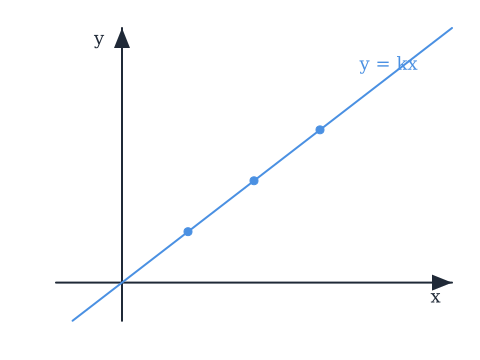
The graph is a straight line through the origin. That makes sense: it is a linear function with nothing added on the end, so it crosses the y-axis at 0, and the gradient of the line is .
The other form: y/x = k
We can also meet direct proportion in the form
It is really the same thing, we have just moved things around a bit in the original form. As we remember from fractions, a fraction is also a ratio. So here we can say that the ratio between and is constant. In direct proportion the ratio between the two variables is constant.
Finding k from one pair of values
This second form is the one we use when we are not told . Say we only know that 3 litres of milk cost £6. Then we have an and a that belong together, and we put them into :
So the constant of proportionality is 2, and the rule is . Now we can find the price of any amount. For 5 litres:
so 5 litres cost £10. Notice that as well: the ratio between price and amount is the same for every pair, which is exactly what direct proportion promises.
Common mistakes
- "k is where the line crosses the y-axis." In there is no constant added on, so the line goes through the origin. is what you multiply by, the gradient of the line, not a crossing point.
- "y grows when x grows, so it must be proportional." Only if it grows in exactly this way, . A taxi at £2 per km plus a £4 start fee is : it grows with , but it is not proportional, because the ratio is not the same for every trip.
- "y/x = k is a different rule from y = kx." It is the same statement, rearranged. Use whichever form suits the question: to compute , to find .
Related
- Back to the pillar: what is proportion?
- The other kind: inverse proportion, where is constant instead.
- The straight line through the origin is a linear function with .
Frequently asked questions
Read next
Want to get good at maths?
Mathara explains every topic step by step with videos, exercises and personal feedback.
👉 Get started for free