Maths dictionary
Units: metres, square metres and cubic metres
A unit is a way of describing how much there is of something. When we multiply lengths, the units get multiplied too, and that is where square metres and cubic metres come from.
A unit is a way we can describe how much there is of something. It can be units like metres, which we use to measure lengths, and kilograms, which we use to measure how much something weighs.
When we calculate things in the real world, units are super important, because they tell us whether we've actually calculated the right thing. Say we had to work out the weight of a car, and we got the answer in metres. Then we probably haven't got it quite right.
Square metres: when we go into 2 dimensions
When we work with 2 dimensions, we can describe sizes too, just like we can describe the distance between 2 towns in metres or kilometres. That's done with the unit square metres (m²). If we look at a square, we can describe its area, that is, what can fit inside the box, in square metres (m²).
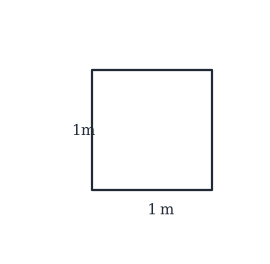
To find the area of this box, we would say
Here we get 1 m², since
So we get a unit called m². The most important thing is that we multiply the m's together as well. The unit is part of the calculation.
Cubic metres: when we go into 3 dimensions
Cubic metres (m³) is a unit we use when we're dealing with 3 dimensions. That is, height, length and width all at once. Exactly the same principle as with the square metre applies here:
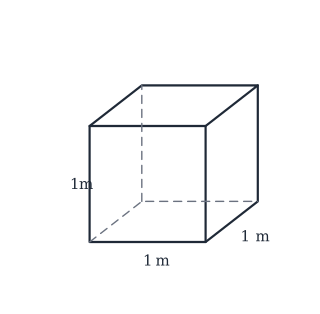
When we calculate what can fit inside a box like this, it's called the volume. The unit for volume is cubic metres (m³). Let's try to work out the volume of this box. Here we would say
Here we see again that the unit on every side length has to come along into the calculation. The unit for the volume of this box is m³, and the volume itself is 1 m³, said out loud as one cubic metre.
The same thing happens with any length unit: centimetres times centimetres gives square centimetres (cm²), and three of them give cubic centimetres (cm³). That's why the formulas for area give square units and the formulas for volume give cubic units.
When do we calculate with units?
In principle we should always calculate with units, but when we calculate simple things, like £20 + £40, it can be easy to calculate without the units, because it's the same unit all the way through the calculation. Calculating with units becomes useful when the things we're calculating get a bit more tangled. Then it's important that we get the answer in the right unit, otherwise we've probably made a mistake. If we're looking for a volume and don't get the unit cubic metres, or cubic centimetres or similar, we have definitely calculated wrong.
Common misunderstandings
- "The unit is just something you write after the number." The unit is part of the calculation. When we multiply 1 m by 1 m, the m's get multiplied too, and that's exactly where m² comes from.
- "An area can be measured in metres." A length is in metres. An area is in square metres, because two lengths have been multiplied together. A volume is in cubic metres, because it's three lengths.
- "The unit doesn't tell you anything about whether the answer is right." It's the first check you have. If you're looking for a volume and your unit isn't a cubic unit, you have definitely gone wrong somewhere.
Related
Units show up every time we calculate an area or a volume: area of a square and a rectangle, area of a circle, and the whole catalogue of 3D shapes with their volumes and surface areas. The flat shapes are in quadrilaterals.
Frequently asked questions
Read next
Want to get good at maths?
Mathara explains every topic step by step with videos, exercises and personal feedback.
👉 Get started for free