Maths dictionary
Quadrilaterals: square, rectangle, parallelogram and trapezium
Every quadrilateral has 4 sides and an angle sum of 360 degrees. Here are the four shapes worth knowing, what makes each one different, and the area formula that goes with it.
There are several types of quadrilateral, but they all share some properties. Every quadrilateral has 4 sides. On top of that, they all have an angle sum of 360 degrees.
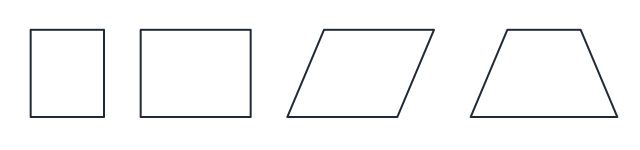
Those two facts are the starting point. The four shapes below are the ones that come up again and again, and each of them has its own area formula. The formulas are short, but they only work if you know which lengths to put into them, so every shape gets a figure with its lengths labelled.
The square
The square is probably the simplest quadrilateral we have. The square has equal side lengths, and all its angles are 90 degrees, which also makes the opposite sides parallel.
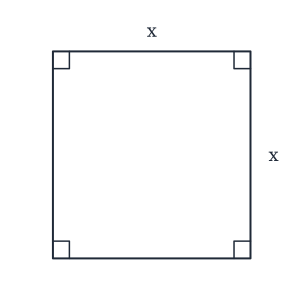
In the figure the sides are all called , because they're all the same length. That's also why the area is
For example, a square with side length 3 has the area . The walkthrough is in the guide about the area of a square and a rectangle.
The rectangle
Like in the square, all the angles are 90 degrees, but here the sides are equal in pairs. In other words, the opposite sides are parallel and equally long.
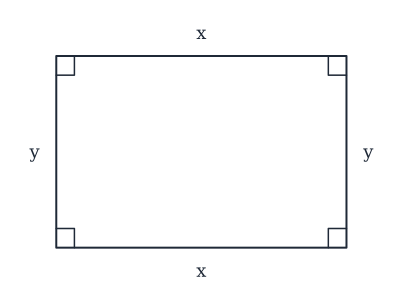
The area is one side length times the other:
So a rectangle with sides 5 and 4 has the area .
The parallelogram
In a parallelogram the sides are equal in pairs and parallel. It looks a bit like a rectangle that has been given a shove on the side, because the parallelogram leans over to one side.
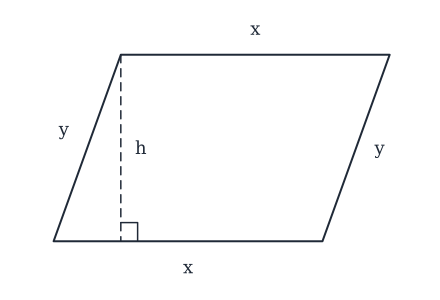
The shove doesn't change the area, but it does change how we find it. It is not the side lengths multiplied together. We take one side length, the base, times the height, and the height is the dashed line that stands straight up from the base:
Why the slanted side doesn't come into it is explained in the guide about the area of a parallelogram.
The trapezium
In a trapezium only one of the pairs of sides is parallel. The angle sum is still 360, as in all other quadrilaterals.
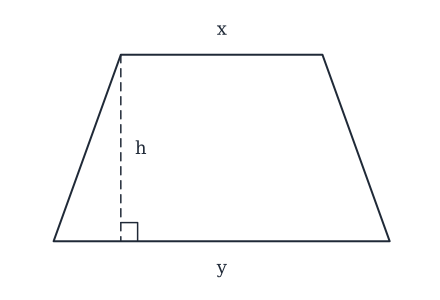
Here and are the parallel sides, and is the height between them. The area formula can look a bit more complicated, but it actually isn't:
We add the two parallel sides together, multiply by the height, and then multiply by a half. The guide about the area of a trapezium takes it step by step.
Triangles have 180, quadrilaterals have 360
It's worth putting the two angle sums next to each other. A triangle has three corners and an angle sum of 180 degrees. A quadrilateral has four corners and an angle sum of 360 degrees. The angle sum belongs to the type of shape, not to the particular one you're looking at, so a long thin rectangle and a leaning parallelogram both have 360.
Units
An area always comes in square units. If the sides are measured in centimetres, the area is in square centimetres. Why area is measured in squares, and volume in cubes, is explained in units: metres, square metres and cubic metres.
Common misunderstandings
- "The angle sum changes with the shape." It doesn't. Every quadrilateral has an angle sum of 360 degrees, square, rectangle, parallelogram and trapezium alike.
- "The area of a parallelogram is side times side." No. The parallelogram has been shoved sideways, and that shove means the slanted side is longer than the height. The area is the base times the height, where the height stands straight up from the base.
- "The trapezium formula is complicated." It looks it, but it isn't. Add the two parallel sides, multiply by the height, take half.
- "Different letters mean a different formula." Some books write the square's area with height and length, some with height and width. The formula is the same: the two side lengths multiplied together.
Related guides
Guides on this topic
Area of a parallelogram
A parallelogram is a rectangle that has been given a shove on the side. The shove doesn't change the area, but it does mean you multiply base by height, not side by side.
Area of a square and a rectangle
For a square and a rectangle the area is the two side lengths multiplied together. The square just happens to have the same length twice.
Area of a trapezium
The trapezium's area formula looks more complicated than it is. Add the two parallel sides together, multiply by the height, then multiply by a half.
Frequently asked questions
Read next
Want to get good at maths?
Mathara explains every topic step by step with videos, exercises and personal feedback.
👉 Get started for free