Guide
Area of a trapezium
The trapezium's area formula looks more complicated than it is. Add the two parallel sides together, multiply by the height, then multiply by a half.
In a trapezium only one of the pairs of sides is parallel. The angle sum is still 360, as in all other quadrilaterals. The area formula for a trapezium can look a bit more complicated than the others, but it actually isn't, and this guide takes it one step at a time.
When do I use this?
Whenever the shape has exactly one pair of parallel sides. If both pairs are parallel you're looking at a rectangle or a parallelogram, and those have their own guides: area of a square and a rectangle and area of a parallelogram.
The formula
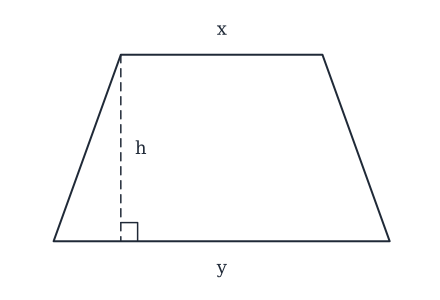
Here and are the parallel sides, and is the height, the dashed line that stands at a right angle between them.
We add the two parallel sides together and multiply by the height, and after that we multiply by a half.
The procedure
- Find the two parallel sides, and , and add them together.
- Multiply by the height .
- Multiply by a half.
The bracket around matters. The two parallel sides are added first, and only then does the height come in.
Worked example
If a trapezium has the parallel side lengths 2 and 4, with a height of 6, the area is
Step by step: the parallel sides add up to . Times the height gives . Half of that is .
Common mistakes
- "The formula is too complicated to remember." It really isn't. Add the two parallel sides, multiply by the height, take half. Three moves.
- "I add the slanted sides." The two sides you add are the parallel ones, and in the figure. The slanted sides aren't in the formula at all.
- "The height is one of the slanted sides." The height is the dashed line that stands straight between the two parallel sides, at a right angle to them.
Related
The trapezium is the last of the four shapes in Quadrilaterals: square, rectangle, parallelogram and trapezium. Its formula sits between the two simpler ones: the rectangle, where you multiply two sides, and the parallelogram, where you multiply the base by the height.
Frequently asked questions
Read next
Want to get good at maths?
Mathara explains every topic step by step with videos, exercises and personal feedback.
👉 Get started for free