Guide
Area of a parallelogram
A parallelogram is a rectangle that has been given a shove on the side. The shove doesn't change the area, but it does mean you multiply base by height, not side by side.
In a parallelogram the sides are equal in pairs and parallel. It looks a bit like a rectangle that has been given a shove on the side, because the parallelogram leans over to one side. That picture is the whole guide: the shove doesn't change the area, but it changes which lengths we multiply.
When do I use this?
Whenever you're asked for the area of a quadrilateral with two pairs of parallel sides that isn't standing up straight. If it were standing up straight it would be a rectangle, and you'd use the area of a rectangle instead.
The formula
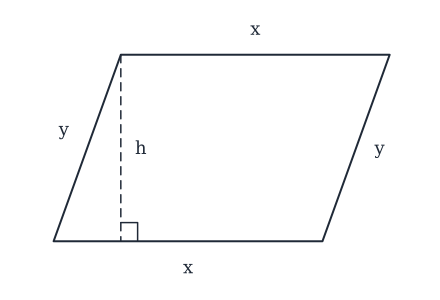
The parallelogram can be seen as a rectangle that has just been given a shove on the side, but that doesn't change the area. However, it is not the side lengths multiplied together. Here we take the one side length, the base, times the height. In the figure the base is and the height is :
The height is the dashed line. It goes from the base straight up to the opposite side, and the small square shows that it stands at a right angle to the base. The slanted side is longer than the height, and it doesn't appear in the formula.
The procedure
- Find the base . Either of the two parallel sides the height is measured between will do.
- Find the height , the distance straight across from the base to the opposite side.
- Multiply base by height.
Worked example
If a parallelogram has the height 4 and the base 6, the area is
Notice that we were never told the slanted side, and we didn't need it. The height is what goes into the formula.
Common mistakes
- "Area is side times side, like a rectangle." That's exactly the trap. The parallelogram has been shoved sideways, so its slanted side is longer than its height. Multiply the base by the height, not by the slanted side.
- "The slanted side is the height." It isn't, unless the parallelogram is actually a rectangle. The height is the dashed line that stands straight up from the base.
Related
The rectangle this formula comes from is in area of a square and a rectangle. The other shape that uses a height in its formula is the trapezium, where only one pair of sides is parallel: area of a trapezium. All four shapes side by side are in Quadrilaterals: square, rectangle, parallelogram and trapezium.
Frequently asked questions
Read next
Want to get good at maths?
Mathara explains every topic step by step with videos, exercises and personal feedback.
👉 Get started for free