Guide
Area of a square and a rectangle
For a square and a rectangle the area is the two side lengths multiplied together. The square just happens to have the same length twice.
The area of a square and the area of a rectangle come from the same move: multiply the two side lengths with each other. The square is just the case where the two sides happen to be the same length.
When do I use this?
Whenever you need to know how much a square or a rectangle covers. These are the two simplest quadrilaterals, and the parallelogram's formula is explained by comparing it with the rectangle.
The square
The square has equal side lengths, and all its angles are 90 degrees, which also makes the opposite sides parallel.
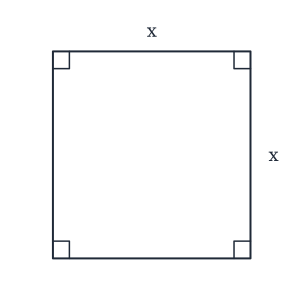
The area of a square is found by multiplying the two side lengths with each other. There are several ways of writing the formula. Some use height and length, and , and some use height and width, and . Since both sides of the square are equally long, in the book they're both simply called :
In the figure we called the side lengths , so that's why it's times .
Worked example
In a square with side lengths 3, the area is
The rectangle
Like in the square, all the angles are 90 degrees, but here the sides are equal in pairs. So the opposite sides are parallel and equally long.
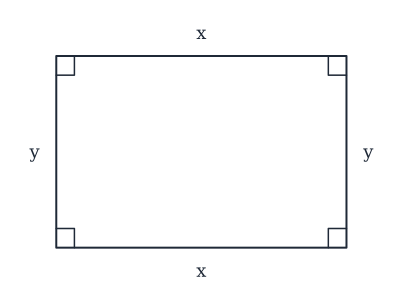
Here we do the same as for the area of the square, and multiply the side lengths with each other. That is, the one side length times the other side length :
Worked example
We could for example have the side lengths 5 and 4. Then the area is
If the sides were measured in centimetres, the area is 20 square centimetres. An area always comes in square units, and units: metres, square metres and cubic metres explains why.
The procedure, in short
- Find the two side lengths. In a square they're the same, so you only need one.
- Multiply them with each other.
- Give the answer in square units.
Common mistakes
- "I need two different measurements for a square." You don't. All four sides are the same length, so one length is enough, and the area is that length times itself.
- "The letters in the formula have to match my book." They don't. Height and length, height and width, or and : the formula is always the two side lengths multiplied together.
- "Area is in centimetres." Area is in square centimetres. You multiplied a length by a length, so the unit is squared too.
Related
The rectangle is the starting point for the two other area formulas in this cluster. A parallelogram is a rectangle that has been given a shove, which is why its formula swaps one side for the height: area of a parallelogram. And the area of a trapezium adds the two parallel sides before multiplying. All four shapes are compared in Quadrilaterals: square, rectangle, parallelogram and trapezium.
Frequently asked questions
Read next
Want to get good at maths?
Mathara explains every topic step by step with videos, exercises and personal feedback.
👉 Get started for free