Guide
Adding, subtracting and scaling vectors
We often need to add vectors, subtract them or multiply a vector by a number. With the coordinates it's just normal arithmetic. Drawn on paper it looks a little different, and that is the part worth understanding.
We often need to add vectors together, subtract them from each other or multiply a vector by a number, which we call scaling the vector. When we calculate with vectors, it shows that vector arithmetic is a bit different from normal arithmetic. The way vectors are added and subtracted can seem a bit unusual if you look at the geometry, so in this guide we do each operation twice: once with the coordinates and once as a drawing.
When do I use this?
Whenever a question gives you two vectors and asks for their sum or their difference, or asks for a multiple like . The vectors are given by their coordinates, written on top of each other, as explained in What is a vector?.
Adding vectors
We can add two vectors by adding their x-coordinates and their y-coordinates respectively. If we have two vectors and , we find the sum like this:
The new vector that appears when we add two vectors together, we can actually call whatever we like. Some might call it , others call it to show that it's put together from and . You just name it the way you want, or the way your teacher says you should.
Let's take an example:
This new vector we can of course also draw. One way to see it is to place the two vectors and end to end and draw in the new vector.
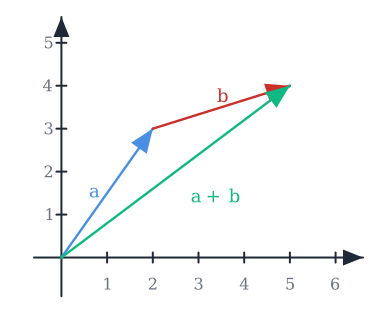
In the picture we can see how we've placed the two vectors end to end, and then connected a new vector from vector 's tail to vector 's head. That green arrow is , and it goes 5 across and 4 up, exactly as the coordinates said.
Subtracting vectors
When we subtract two vectors from each other, it's the same way as with plus. So the coordinates are just subtracted from each other:
Let's take an example. We have to subtract from :
If we only look at the numbers, we just subtract the coordinates from each other:
Graphically it's a bit different from when we add two vectors. But we can say that subtracting from is the same as adding to the negative . So like this:
We can use that to draw the new vector. The negative is actually just a vector that goes in the exact opposite direction. Then we can draw it in our coordinate system together with and place it end to end.
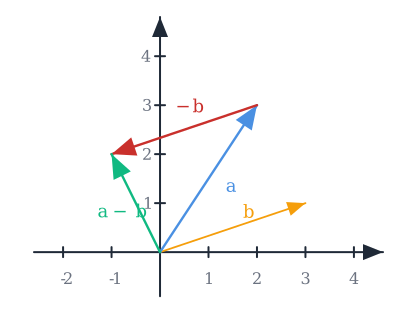
In the picture the original is drawn in orange, points the opposite way and starts where ends, and the green arrow from 's tail to the head of is . It goes 1 back and 2 up, which matches the coordinates and .
Multiplying a vector by a number (scaling)
We can also multiply a number by a vector. When we do that, we call it scaling the vector. In vector arithmetic a normal number is often called a scalar. When we scale a vector, we actually only change its length. Depending on how big the scalar is, the vector gets longer or shorter. If, for example, we want to make a vector twice as long, we have to multiply it by 2:
The way we do it is to multiply both vector coordinates by 2:
With our from before that gives : twice as far across and twice as far up, so twice as long and pointing the same way.
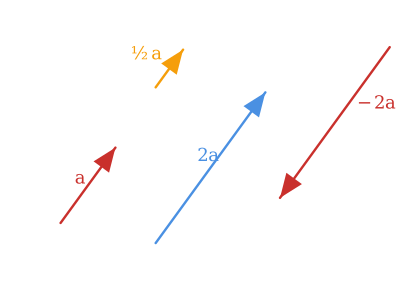
Graphically the vector just gets longer or shorter when we multiply it by a scalar. As the picture shows, the vector gets shorter if we multiply by a number between 0 and 1. At the same time, a vector can also be multiplied by a negative number, which results in the vector simply pointing in the opposite direction. It's still scaled, of course, just in the opposite direction.
Dividing a vector by a number
This is actually the same as multiplying a number by a vector. It just scales the vector. Here we have to remember that division can be written as multiplication. For example
Dividing by 2 is the same as multiplying by a half. So dividing a vector by a number is scaling it, exactly as above.
Common mistakes
- "Adding the coordinates is the whole story." With the coordinates, yes, but there is a picture too: place at the head of , and the sum runs from 's tail to 's head. If your drawing doesn't match your coordinates, one of them is wrong.
- "Subtraction is a brand new operation." It isn't. is , and is just turned round to point the opposite way.
- "Multiplying by a negative number only flips the vector." It flips it and scales it. is twice as long as and points the opposite way.
- "Scaling changes the direction." A positive scalar only changes the length. The vector points the same way, it's just longer or shorter.
Related
Frequently asked questions
Read next
Want to get good at maths?
Mathara explains every topic step by step with videos, exercises and personal feedback.
👉 Get started for free