Maths dictionary
What is a vector?
A vector is an arrow with a direction and a length. Its coordinates say how far it goes across and how far up, and two arrows with the same length and direction are the same vector, wherever they sit.
In physics we very often describe how things are affected by forces and how they affect each other. The different forces in a system have to be described mathematically somehow, so that we can actually calculate with them. To describe how things are affected by forces, we use what we call vectors. Examples of situations where we use vectors could be how gravity affects a ball we throw up in the air, or how a block slides down a wooden ramp. But vectors aren't only used to describe physical situations, they're also used for problem solving in maths.
A vector is an arrow with a direction and a length
In two dimensions, that is on a flat piece of paper, we can describe a vector as an arrow with a direction and a length. That is a perfectly good definition for everything we do here.
A vector's direction and length are what matter about it. Two vectors with different directions but the same length are not the same vector, and the other way round: the same direction but a different length is not the same vector either.
Vector coordinates
Just as points have coordinates to describe their position, a vector has coordinates too. We call them vector coordinates, and they show how far the vector goes in the x-direction and how far it goes in the y-direction. We write the vector coordinates on top of each other in a pair of tall brackets, which is a kind of table. When we mark a vector, we do it with a small arrow over the letter:
Here describes how long the vector is in the x-direction, and describes how long the vector is in the y-direction. This vector is called , and it has the small arrow over it to show that it's a vector. In the exam you'll also see vectors written as a bold letter or with a line under the letter. It's the same thing.
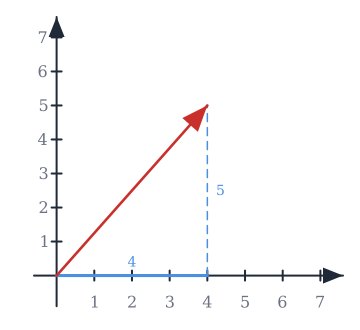
We can find the vector coordinates of the vector in the picture by looking at how long it is in the x- and y-direction. We can see that the vector goes 4 out along the x-axis and 5 up the y-axis. So this vector's coordinates are
The same vector in different places
Even if two vectors sit in different places in the coordinate system, they're still the same vector if they have the same length and direction. Here it's important to see that the vector's coordinates aren't measured from the origin, , but from the vector's own starting point.
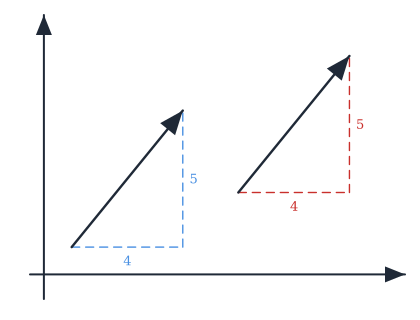
In the picture we can see two vectors which admittedly sit in different places, but have the same length and direction. So these two vectors are the same.
That is also why a vector is the natural way to describe a translation: when we push a figure, every corner moves by the same vector, wherever that corner is. You can see that in the guide on translation.
The length of a vector
We can find a vector's length if we look at the vector as a right-angled triangle, where the vector itself is the hypotenuse.
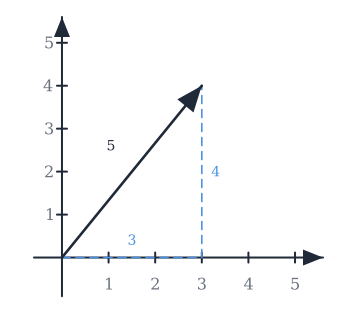
Here we can use Pythagoras' theorem to find the hypotenuse, that is the length of the vector. We take the vector's x-coordinate as one of the shorter sides and the y-coordinate as the other. Then we can find the length of the vector:
If a vector had the coordinates , we use Pythagoras to find the length:
So the length of the vector with coordinates 3 and 4 is 5.
When we're dealing with the length of a vector, we show it with two vertical bars. The length of a vector we call we would write as
Doing arithmetic with vectors
We often need to add vectors together, subtract them from each other or multiply a vector by a number, which we call scaling the vector. When we calculate with vectors, it shows that vector arithmetic is a bit different from normal arithmetic. The way vectors are added and subtracted can seem a bit unusual if you look at it geometrically, even though with the coordinates it's just normal adding and subtracting. That gets its own guide: Adding, subtracting and scaling vectors.
Common misunderstandings
- "A vector is defined by where it sits." No. A vector is its direction and its length. Two arrows in different places with the same length and direction are the same vector.
- "Vector coordinates are measured from the origin." No. They're measured from the vector's own starting point: how far it goes across and how far up from where it starts.
- "A vector's coordinates are the same as a point's coordinates." Points have coordinates to describe their position. A vector's coordinates say how far it goes in the x-direction and the y-direction, wherever it starts.
- "Same length means same vector." Two vectors with the same length but different directions are not the same vector. Both the direction and the length have to match.
Related guides
Guides on this topic
Frequently asked questions
Read next
Want to get good at maths?
Mathara explains every topic step by step with videos, exercises and personal feedback.
👉 Get started for free