Guide
Translation: moving a shape with a vector
Translating a figure means pushing it to a new place without turning it. Every corner moves the same way, so the arrow from one corner to its new place, a vector, describes the whole move.
When we translate a figure, we keep its shape. We can see it as if we simply push the figure around on the paper. The typical task is to move a figure so that one of its corners lands on a given point, and the thing to get right is that every other corner has to move in exactly the same way.
When do I use this?
Translation is one of the three moves in transformations. A typical translation task is about moving a figure so that one of its corners lies at a different point. In the exam the move is usually given to you as a vector: so many across and so many up or down. That is the same thing as the arrow from a corner to where that corner ends up, and we'll come back to it below.
The procedure
- Find the corner that has to move, and the point it has to move to.
- Push the figure until the chosen corner lies in the right place. The figure has to stay exactly as it is while you push it: its side lengths and angles are kept.
- Every other corner moves the same distance in the same direction. Check it: the lines between the old corners and the new corners are all parallel.
- Draw the figure in its new place.
Worked example
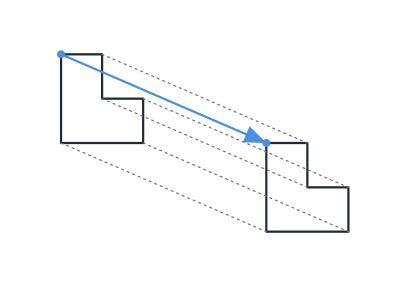
In the picture the L-shaped figure has to be moved so that its top left corner, the first blue point, lands on the second blue point. The blue arrow shows the move: 5 to the right and 2 down. So we push the whole figure 5 to the right and 2 down.
When we translate the figure, it's important to remember that the figure's side lengths and angles are kept. So the figure stays exactly as it is, we just push it around. In other words, we move the figure so that all the lines between the corners are parallel. You can see that in the picture: the thin dotted lines from each old corner to its new corner all run the same way, and they are all the same length.
Describing the move as a vector
The blue arrow in the picture is a vector: an arrow with a direction and a length. Its coordinates say how far it goes in the x-direction and how far in the y-direction, and we write them on top of each other:
The top number is the move across, 5 to the right. The bottom number is the move up, and here it is , which means 2 down. That is how a translation is described in the exam. Every corner of the figure is moved by that same vector. You can read more about vectors and their coordinates in What is a vector?.
Common mistakes
- "I turned the figure a little while I moved it." A translation is only a push. The figure stays exactly as it is: same side lengths, same angles, same way up. If it got turned, that is a rotation, not a translation.
- "I moved one corner to the right place and drew the rest by eye." Every corner has to move the same distance in the same direction. Check that the lines between the old and new corners are all parallel and the same length.
- "The bottom number in the vector is how far down." The bottom number is how far up. A negative number means the figure moves down. So 5 across and 2 down is written with a at the bottom.
Related
Frequently asked questions
Read next
Want to get good at maths?
Mathara explains every topic step by step with videos, exercises and personal feedback.
👉 Get started for free