Guide
Rotation about a centre
Rotating a figure means turning it round a centre of rotation. The figure keeps its shape. You turn each corner the given angle round the centre, then join the new corners up.
When we rotate a figure, it gets turned round a centre of rotation. The figure still has the same shape, it's just turned round. To carry out a rotation you need to know three things: the centre of rotation, the angle you turn through, and which way round you turn, clockwise or anticlockwise. The hurdle is that you can't turn the whole figure in one go by hand, so you do it corner by corner.
When do I use this?
Rotation is the third of the three moves in transformations. The task gives you a figure, a centre of rotation and an angle, and in the exam it also tells you which way round to turn, clockwise or anticlockwise. The centre of rotation is the point we turn the figure round. It can lie outside the figure, but the centre of rotation can perfectly well lie inside the figure too.
The procedure
If we, for example, have to rotate a triangle 90 degrees round a centre of rotation, the way we do it is to turn each corner of the figure 90 degrees round the centre.
- Mark the centre of rotation.
- Take one corner of the figure. Turn it 90 degrees round the centre: it stays the same distance from the centre, it just swings round through 90 degrees. Mark the new point.
- Do the same with each of the other corners.
- Now we can connect our new points, and that is our triangle turned 90 degrees.
Worked example
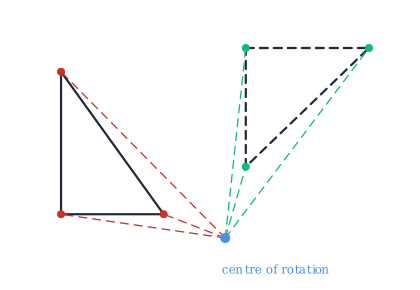
In the picture we have a right-angled triangle and a centre of rotation, the blue point, outside the triangle. The dashed triangle shows where this triangle ends up after a rotation of 90 degrees.
Look at the dashed lines from the centre. Each red line goes from the centre to one of the original corners, the red points. Turn that line 90 degrees round the centre, and it becomes a green line ending at a green point. That green point is the new corner. When all three corners have been turned, we connect the green points, and the dashed triangle is our triangle rotated 90 degrees.
Roughly right is fine
When we get these tasks in tests or homework sets, it's typically "roughly right", because it's hard to make a perfect rotation without a computer tool. The point of the task is just to see whether you've understood what a rotation is about: a centre, an angle, and each corner turned round the centre.
Common mistakes
- "The centre of rotation has to be outside the figure." No. The centre of rotation can perfectly well lie inside the figure.
- "I turned the figure but forgot about the centre." A rotation is always round a centre of rotation. Turning the figure on the spot is a rotation round a centre inside it, and turning it round a point outside it moves it to a completely different place. The centre decides where the figure ends up.
- "My drawing isn't exact, so it must be wrong." By hand a rotation is typically roughly right. What's being checked is that each corner was turned the right angle round the centre.
- "Rotating changes the shape." No. The figure still has the same shape, it's just turned round.
Related
Frequently asked questions
Read next
Want to get good at maths?
Mathara explains every topic step by step with videos, exercises and personal feedback.
👉 Get started for free