Maths dictionary
Transformations: reflection, translation and rotation
Reflection, translation and rotation are three ways of moving a figure. The figure keeps its shape every time: it is mirrored, pushed or turned, never changed.
Reflection, translation and rotation are three ways of moving a figure. Whichever one we use, the figure keeps its shape. When we reflect a figure, it's exactly like seeing it in a real mirror. When we translate it, we just push it around on the paper. And when we rotate it, we turn it round a point we call the centre of rotation.
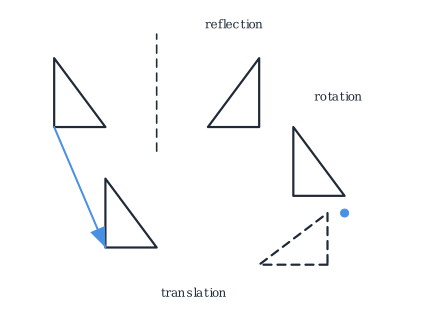
That is the thing to hold on to through this whole topic: the figure stays exactly as it is. Its side lengths and its angles are kept. We only mirror it, push it or turn it.
Reflection: the figure in a mirror
When we reflect a figure, it's exactly like seeing the figure in a real mirror. You may have done an exercise in maths class where real mirrors are used to see it. When we reflect a figure, we do it across a mirror line, exactly as if we had placed a mirror in front of the figure.
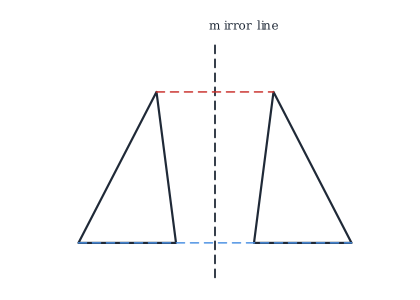
In the picture we've reflected a triangle. We reflect a figure by drawing the same distance from each corner of the figure to the mirror line. The lines have to be at right angles, that is 90 degrees, to the mirror line. The corners of the reflection have to be just as far from the mirror line as the corners of the original figure are.
The mirror line doesn't have to be vertical or horizontal. It can be slanted too, and then we still make sure the distance from the reflection's corners to the mirror line is just as big as the distance from the original figure's corners. The full walkthrough is in the guide on reflection.
Translation: pushing the figure
When we translate a figure, we keep its shape. We can see it as if we simply push the figure around on the paper. A typical task in translation is to move a figure so that one of its corners lies at a different point.
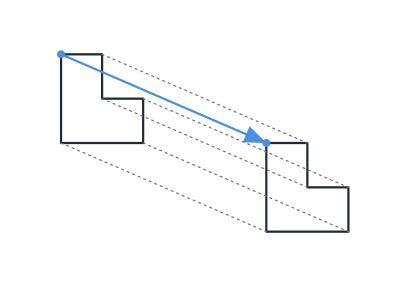
When we translate the figure, it's important to remember that the figure's side lengths and angles are kept. So the figure stays exactly as it is, we just push it around. In other words, we move the figure so that all the lines between the old corners and the new corners are parallel.
The arrow from a corner to its new place tells you the whole move: how far across and how far up or down. That arrow is a vector, and in the exam a translation is described with one. You can read more about that in What is a vector? and in the guide on translation.
Rotation: turning the figure round a centre
When we rotate a figure, it gets turned round a centre of rotation. The figure still has the same shape, it's just turned round. The centre of rotation is the point we turn the figure round. The centre of rotation can perfectly well lie inside the figure too.
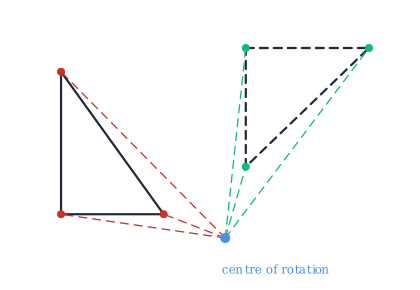
If we, for example, have to rotate a triangle 90 degrees round a centre of rotation, the way we do it is to turn each corner of the figure 90 degrees round the centre. Then we can connect our new points, and that is our triangle turned 90 degrees.
When we get these tasks in tests or homework sets, it's typically "roughly right", because it's hard to make a perfect rotation without a computer tool. The point of the task is just to see whether you've understood what a rotation is about. The step-by-step version is in the guide on rotation.
What the three moves have in common
In all three cases the figure keeps its shape: the same side lengths, the same angles. We only change where the figure is and which way round it sits. That is what makes them different from a scale drawing, where the shape stays the same but the size changes.
The three moves also differ in what you need to know to carry them out. A reflection needs a mirror line. A translation needs to know where one corner ends up, because every other corner moves the same way. A rotation needs two things: a centre of rotation and an angle.
Common misunderstandings
- "The mirror line has to be vertical or horizontal." No. It can be slanted. The rule is the same: every corner of the reflection is just as far from the mirror line as the original corner, measured at right angles to the line.
- "Reflecting or rotating a figure changes its shape." No. In all three moves the figure keeps its side lengths and angles. It's the same figure in a new place.
- "The centre of rotation has to be outside the figure." No. The centre of rotation can perfectly well lie inside the figure.
- "My rotation has to be perfect." When you draw it by hand, it's typically roughly right, because a perfect rotation is hard without a computer tool. What's being checked is whether you understand what a rotation is.
Related guides
Guides on this topic
Reflection in a mirror line
Reflecting a figure is exactly like seeing it in a real mirror. Each corner of the reflection sits just as far from the mirror line as the original corner, measured at right angles to the line.
Rotation about a centre
Rotating a figure means turning it round a centre of rotation. The figure keeps its shape. You turn each corner the given angle round the centre, then join the new corners up.
Translation: moving a shape with a vector
Translating a figure means pushing it to a new place without turning it. Every corner moves the same way, so the arrow from one corner to its new place, a vector, describes the whole move.
Frequently asked questions
Read next
Want to get good at maths?
Mathara explains every topic step by step with videos, exercises and personal feedback.
👉 Get started for free