Guide
Reflection in a mirror line
Reflecting a figure is exactly like seeing it in a real mirror. Each corner of the reflection sits just as far from the mirror line as the original corner, measured at right angles to the line.
When we reflect a figure, it's exactly like seeing the figure in a real mirror. The figure keeps its shape, it's just flipped over to the other side of a mirror line. The thing that trips people up is getting every corner the right distance from the line, and measuring that distance the right way.
When do I use this?
You may have done an exercise in maths class where real mirrors are used to see what a reflection looks like. On paper we do the same thing with a mirror line: we reflect the figure across it exactly as if we had placed a mirror in front of the figure. In the exam the mirror line is often drawn on a coordinate grid, but the rule doesn't change. What matters is the distance from each corner to the line.
Reflection is one of the three moves in transformations, together with translation and rotation. In all three the figure stays the same, we just move it.
The procedure
We reflect a figure by drawing the same distance from each corner of the figure to the mirror line, on the other side of the line.
- Pick a corner of the figure.
- Draw the line from that corner to the mirror line. This line has to be at right angles, that is 90 degrees, to the mirror line.
- Measure how far it is from the corner to the mirror line, and mark the same distance on the other side. That is where the reflected corner goes. The reflection's corner has to be just as far from the mirror line as the original corner is.
- Do the same for every corner.
- Connect the new corners, and you have the reflected figure.
Worked examples
A vertical mirror line
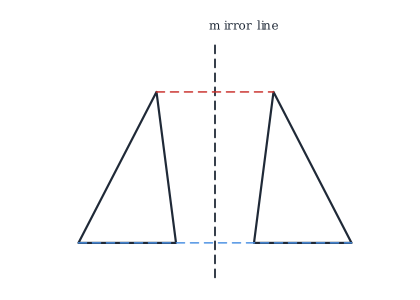
In the picture we've reflected a triangle in a vertical mirror line. Look at the top corner: the dashed red line goes from the corner straight across to the mirror line, at right angles to it, and continues the same distance on the other side. That is where the top corner of the reflection sits. The two bottom corners are done the same way along the blue line. When all three corners are in place, we connect them, and the reflected triangle is finished.
A slanted mirror line
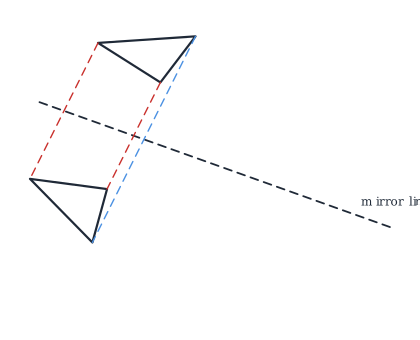
Another example could be if the mirror line was not vertical or horizontal. Here we still have to make sure that the distance between the reflection's corners and the mirror line is just as big as the distance from the original figure's corners to the mirror line. The only difference is that "at right angles to the mirror line" now means along a slanted line, so the dashed measuring lines run across at a slant too. Corner by corner it's exactly the same job.
Common mistakes
- "The mirror line has to be vertical or horizontal." No. The mirror line can be slanted, and the rule is exactly the same: same distance from the line, measured at right angles to it.
- "I measure straight across, even when the line is slanted." The distance always has to be measured at right angles to the mirror line, that is 90 degrees to it. If the line is slanted, your measuring lines are slanted too.
- "The reflection can come out a bit bigger or smaller." No. Every corner is the same distance from the line as its original, so the figure comes out exactly the same, just flipped.
Related
Frequently asked questions
Read next
Want to get good at maths?
Mathara explains every topic step by step with videos, exercises and personal feedback.
👉 Get started for free