Guide
Translating graphs: f(x) + k and f(x − k)
There are two ways to translate a graph: up the y-axis or along the x-axis. Up is easy, you add to the function. Sideways is the one that catches people, because moving right means subtracting from x.
When we translate a function, there are 2 ways we can do it. We can push the graph along the x-axis, or up the y-axis. The vertical one is straightforward. The horizontal one is the one that catches people, because it doesn't feel intuitive, so it gets the most room here.
When do I use this?
Whenever a question shows you the graph of and asks you to sketch or , or asks which translation takes one graph onto another. You need function notation for the language, and the parabola is the running example because it's the shape the book uses.
Shifting up the y-axis
Let's say we have the function
Right now the graph crosses the y-axis at 0, but let's say we wanted to translate the function so that it crossed the y-axis at 5. So that it lands like the dotted graph in the picture below.
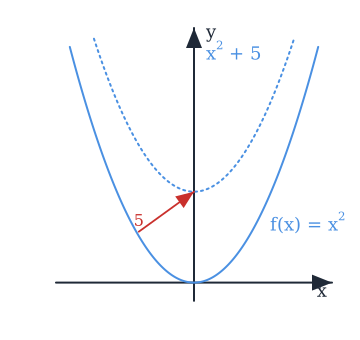
We can see a shift up the y-axis as just taking all the points on the graph and pushing them upwards, that is, adding some particular value to their y-value. If we move one point up, we simply have to add 5 to the y-value before the point has been translated upwards: the point becomes .
If we want to translate the whole function by 5, we therefore have to add 5 to our function:
and then the whole function is translated upwards by 5.
We can write in general that if we want to move a function up the y-axis, that is, translate the function up the y-axis, we add a value to the function:
Shifting along the x-axis
When we translate a function along the x-axis, we can see it as just taking all the points' x-values on the graph and pushing them. That is, we add or subtract some value from the x-value. But this one is a bit more involved than shifting up the y-axis. When we want to translate a graph to the right by, say, 5, we actually have to subtract 5 from our x-value:
Here the function gets translated 5 to the right. When we shift to the left, we add instead:
If our function was , a translation of 5 to the right would be .
It doesn't feel intuitive to subtract when we want to translate the function to the right, and add when we translate to the left, but there is actually an explanation for it. Let's take an example.
Why moving right means subtracting
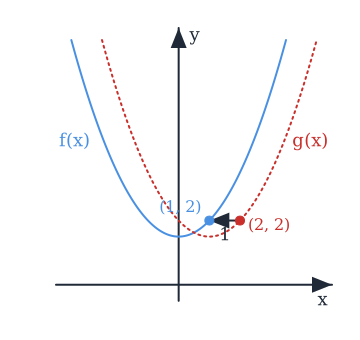
Here we have our function and the translated function, which we call . has been pushed to the right along the x-axis. We've marked the point , which lies on . If we wanted to move this point across onto , we'd just have to subtract 1 from the point's x-value. The point over on therefore gets the name
All we did was take one off the x-coordinate:
We can say that if the point lies on the graph , then the point lies on the graph . That was specific to our example, so if we wanted to say it in general, we could write that if the point lies on the graph , then the point lies on the graph . Here is the value we want to translate by, which in our example was 1.
Because our point lies on the graph , we can say in general that
that is, the y-value of the point is simply the function value of the function, just as the picture shows. We also know that
because we can find the point across on the graph of by subtracting from the x-value. So we can find the "shifted" point across on the graph of by taking off the x-value, just like we did in our example.
Here we can see that both and are equal to , so they're also equal to each other:
What this says is that if we want to translate a function to the right by the value , we have to subtract the value from in our function. It can feel strange that translating a function to the right means we subtract.
Worked example: x² pushed 1 to the right
If we translate the function by 1 to the right, we subtract 1 from the x-value:
Here it's important to remember that it's only the x-value we subtract 1 from, so we write
If we draw it, the graphs look like this:
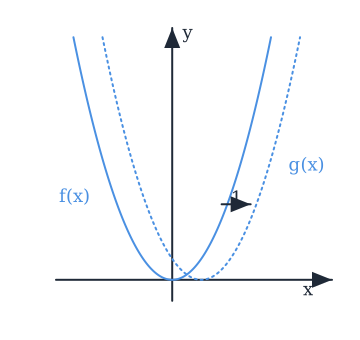
It doesn't feel so intuitive to subtract a value when the graph is to be moved to the right, but you get used to it quickly.
The rule in short
If we want to translate a function to the right along the x-axis by a value , we subtract from :
If we want to translate a function to the left along the x-axis by a value , we add to :
And up the y-axis by :
Common mistakes
- "f(x − 5) moves the graph 5 to the left." It moves it 5 to the right. A point on the shifted graph sits over the point on the original, which is why the 5 is subtracted inside the bracket. It feels backwards, and you get used to it quickly.
- "To move x² 1 to the right I write x² − 1." That moves it down by 1. Only the x-value gets the 1 taken off, so the shifted function is .
Related
Frequently asked questions
Read next
Want to get good at maths?
Mathara explains every topic step by step with videos, exercises and personal feedback.
👉 Get started for free