Maths dictionary
Quadratic functions and the parabola
A quadratic function is written f(x) = ax² + bx + c, and its graph is a parabola with one turning point. Here is what the three numbers a, b and c do to the graph, and what the roots are.
A quadratic function is a type of function that, just like the linear function and the exponential function, has its own equation. It's closely tied to the quadratic equation, which we'll come to further down. The equation for a quadratic function looks like this:
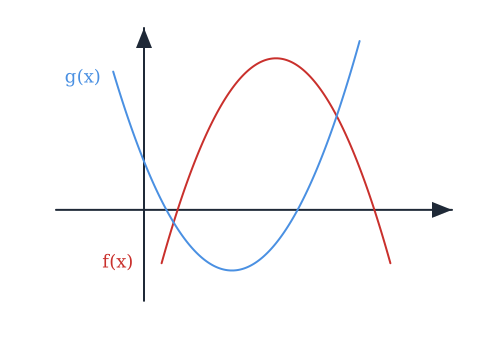
Here the function has three values, , and , that control what the graph looks like. We call the graph of a quadratic function a parabola. A parabola has a turning point, which is the place where the function value is highest (or lowest, as with in the picture). When the turning point sits at the top we can also just call it the top point, and when it sits at the bottom, the bottom point.
What a does
In the linear function the number in front of is the gradient, but a quadratic doesn't have one fixed gradient for the whole function. We can see in the picture above that grows much faster at the start of the graph than it does up by the turning point. If we had to come up with a good description of , we'd say that it describes how the graph curves.
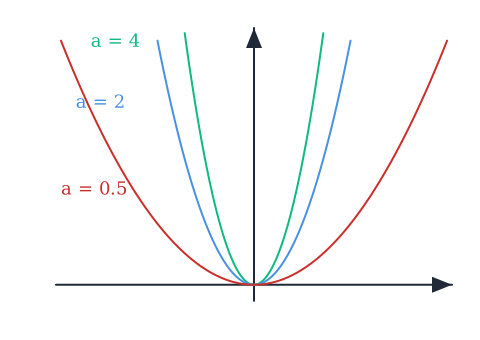
As we can see in the picture, the arms of the parabola come closer together the bigger is. In fact, if is , we get a straight line, which also makes sense if we try putting in 's place in the function:
Here we can see that the whole term disappears, because it's multiplied by , so we end up with a linear function:
That's exactly the same as the way we normally see a linear function, . There are just some other letters, but the structure is exactly the same: a number multiplied on the independent variable , and a number added on. That's also why is never in a quadratic.
If is negative, on the other hand, we get a parabola where the arms point downwards, like in the first picture.
What b does
In a quadratic, tells us directly what the gradient is at the point where the graph crosses the y-axis. More precisely, it's the gradient of the tangent at that point, the straight line that just touches the graph there.
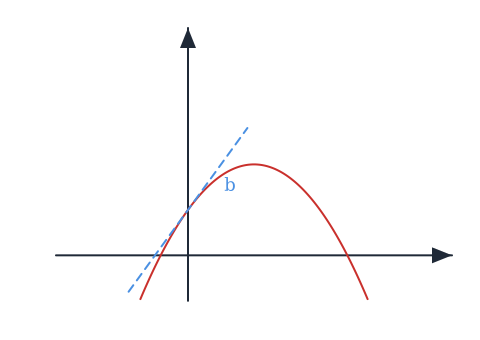
In the picture the tangent is drawn in at the point where the graph crosses the y-axis. The gradient we see there is the -value. If the gradient of the tangent were , would be . Explaining why it's exactly takes a tool called differentiation, which comes after GCSE, so for now we just use it.
also has a second meaning, and it's tied to : together they decide which side of the y-axis the turning point lies on. To look closer at that we need the turning point formula, which gives us the x-coordinate of the turning point:
If the turning point is to lie on the left of the y-axis, has to be negative. Looking at the formula, we can see that comes out negative when and have the same sign. If we try putting in numbers with the same sign in 's and 's places, we do get a negative x-value:
If is to be positive, so the turning point lies on the right of the y-axis, and must have different signs. Again we can see it by putting in numbers with different signs:
The turning point gets its own guide, the turning point of a parabola, where we find both of its coordinates.
What c does
The -value is where the graph crosses the y-axis. We can see that quickly if we put in 's place in the function. If is , we're on the y-axis, after all.
So the crossing with the y-axis is the -value, when we show it this way.
The quadratic equation and the roots
A quadratic equation is closely related to a quadratic function. A quadratic equation has the form
That's actually exactly the same as a quadratic function. Here is just equal to . So when we solve the equation, we find the place on the quadratic where .
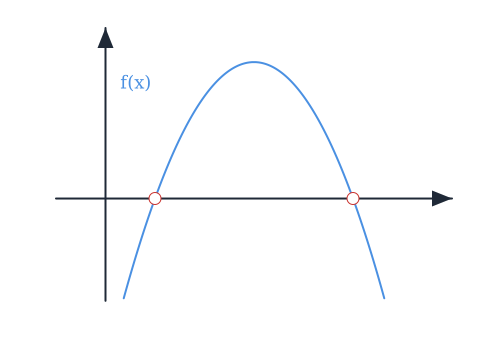
We call these the roots of the function. When we solve the equation, we're finding the x-values that give the roots. So if you need to find the roots of a quadratic, you solve this type of equation. When we solve quadratic equations, we use a formula called the quadratic formula:
The sign means both plus and minus. That means we can have 2 solutions: one with and one with . The parabola can cross the x-axis in 2 places, after all, as we can also see in the picture. It doesn't always, though. What the part under the root does, and how the whole thing works, is in the guide on solving quadratic equations with the formula.
There's also a second way of writing a quadratic, with brackets, where you can read the roots straight off. That's the factorised form, and it gets its own guide about factorising quadratics. And when the equation is already written as brackets multiplied together, the zero product rule solves it in two lines. See solving quadratics by factorising.
Common misunderstandings
- "a is the gradient, like in a straight line." No. In the linear function the number in front of is the gradient, but a quadratic doesn't have one gradient for the whole function. describes how the graph curves: how close together the legs sit, and whether they point up or down.
- "a can be 0 in a quadratic." If is , the term is multiplied by and disappears, and what's left is , a straight line. That's exactly why a quadratic needs to be something other than .
- "The quadratic equation and the quadratic function are two different things." They're the same thing. The equation is the function with set equal to , and its solutions are the roots, the places where the graph crosses the x-axis.
- "The formula only gives one answer." The means both plus and minus, so the formula gives 2 answers when the parabola crosses the x-axis twice.
Related guides
Guides on this topic
Factorising quadratics: the factorised form
A quadratic can be written with brackets as a(x − r₁)(x − r₂), the factorised form. It is the same function as ax² + bx + c, but the roots are sitting right there in the brackets.
Solving quadratic equations by factorising: the zero product rule
If a quadratic equation is written as two brackets multiplied together that equal 0, you don't need the quadratic formula. The zero product rule solves it in two lines.
Solving quadratic equations with the quadratic formula
A quadratic equation ax² + bx + c = 0 is solved with one formula. Find a, b and c, put them in, and the part under the square root tells you in advance whether you get two solutions, one or none.
The turning point of a parabola
The turning point is the top or bottom of the parabola, and a formula finds it straight from a, b and c. Here is the formula, why the point is where the graph turns, and a worked example.
Frequently asked questions
Read next
Linear functions and straight-line graphs (y = mx + c)
DictionaryWhat is a function?
GuideSolving quadratic equations with the quadratic formula
GuideFactorising quadratics: the factorised form
GuideSolving quadratic equations by factorising: the zero product rule
GuideThe turning point of a parabola
Want to get good at maths?
Mathara explains every topic step by step with videos, exercises and personal feedback.
👉 Get started for free