Guide
Solving quadratic equations with the quadratic formula
A quadratic equation ax² + bx + c = 0 is solved with one formula. Find a, b and c, put them in, and the part under the square root tells you in advance whether you get two solutions, one or none.
A quadratic equation, , is solved with one formula. The whole job is to find , and in your equation, put them into the formula, and work out the two answers. The usual hurdle is keeping the signs right along the way.
When do I use this?
You use the formula whenever you have to solve an equation of the form . Solving it is exactly the same as finding the roots of the quadratic function , that is the places where the parabola crosses the x-axis. If your equation is already written as two brackets multiplied together, the zero product rule is quicker.
The formula
When we solve quadratic equations, we use a formula that looks like this:
The part under the square root, , is the piece that decides how many solutions there are. It has a name too, the discriminant, though at GCSE you'll mostly just hear it called the bit under the square root. The sign means both plus and minus. That means we can have 2 solutions: one with and one with . The parabola can cross the x-axis in 2 places, after all. It doesn't always, though, and that's where the part under the square root comes in.
What the part under the square root tells you
The value of tells us something about how many solutions the quadratic equation has. There is more than one possibility:
How do we know this? The number sits under a square root. You can't find 2 numbers that give a negative number when multiplied by themselves, so you can't take the square root of a negative number. If you multiply a negative number by itself, you always get a positive number. Minus times minus gives plus. So we know there are no solutions if is below .
If , we take the square root of , which just gives , and then it makes no difference whether there's a plus or a minus in front of it. So there is only 1 solution when .
If is bigger than , a positive number, the sign comes into play. Then there are 2 solutions: one where we use and one where we use . This becomes clearer in the example we take now.
Worked example
Let's take a small example of a quadratic equation:
We want to solve this equation, but before we do, notice how it's tied to the quadratic function. Solving this quadratic equation is the same as finding the roots of the function
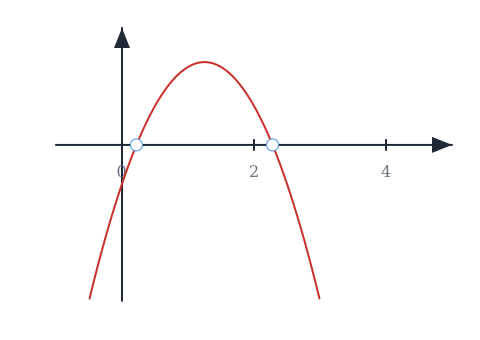
So we have to find the x-values of these 2 crossing points with the x-axis. To find them, we use the quadratic formula:
Now we have to identify , and . We remember that the general quadratic function has the equation
When we look at our equation, we can see that
It's important to remember the signs on the numbers. All we have to do now is put our numbers into their places in the formula:
Now we just simplify:
Now that we've simplified, we look at the plus solution (the one with ) and the minus solution (the one with ):
When we work these two fractions out, we get
So these are our 2 solutions to the equation. We can also see on the graph of the quadratic function that they match the roots.
Common mistakes
- "I put the numbers in, but forgot their signs." Here and , both negative. In that gives , not . Write , and down with their signs before you touch the formula.
- "The formula gives one answer." The means both plus and minus, so there is a plus solution and a minus solution. Work out both.
- "The discriminant is negative, so I take the square root anyway." You can't take the square root of a negative number, so the equation has no solutions. The parabola never reaches the x-axis.
- "The equation and the graph are two different problems." They're the same problem. The solutions are the x-values where the graph crosses the x-axis, which is also the easiest way to check your answer.
Related
The idea behind all of this, the parabola and its roots, is in Quadratic functions and the parabola. If the equation is written as brackets multiplied together, use the zero product rule instead, and to see how the roots sit inside the brackets, read factorising quadratics. The discriminant turns up once more when we find the turning point of a parabola.
Frequently asked questions
Read next
Want to get good at maths?
Mathara explains every topic step by step with videos, exercises and personal feedback.
👉 Get started for free