Guide
Factorising quadratics: the factorised form
A quadratic can be written with brackets as a(x − r₁)(x − r₂), the factorised form. It is the same function as ax² + bx + c, but the roots are sitting right there in the brackets.
A quadratic can be written in two ways: the usual form , and a form with brackets, , which we call the factorised form. It's the same function, just rewritten, and it has one big advantage: you can read the roots straight off it. The usual hurdle is the sign inside the brackets.
Terms and factors
First we need to talk about what a factor is, which is actually really simple. In a calculation or an equation we have terms and factors. Terms we know already: they're separated by plus and minus. Say we have the quadratic
Then we can split it up into terms: , and , separated by the plus and the minus. But we also have factors, and they're separated by multiplication. In the first term, , the factors are and . If you want more on terms, they're covered in simplifying expressions.
When we factorise, we try to reduce the number of terms by forming some brackets. That way the whole thing becomes more compact.
The factorised form
Let's take an example. Say we have the quadratic function
It can be factorised to
As we can see, some brackets were formed. That's what we call a factorised quadratic, or a quadratic in factorised form. And there's a good reason to like factorised quadratics. Let's look at the graph of our quadratic before it was factorised:
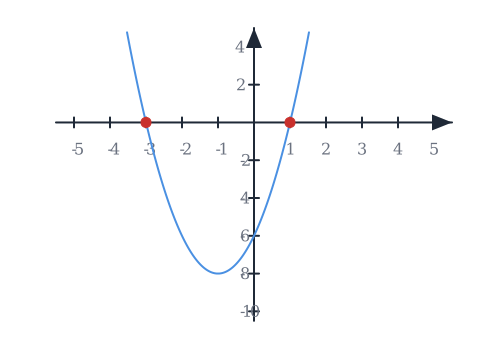
If we look at the roots, we can see that they actually match the numbers inside the brackets in the factorised version (apart from the sign, of course). In our factorised version we have and in the brackets, and the roots of our quadratic are and . Let's look a bit closer at that.
Why we use the factorised form
The factorised form looks like this:
Here the -value is just the -value of our quadratic. And we actually also have the roots of the quadratic, and . So with the factorised version of a quadratic we can read the roots off directly.
Let's take an example. We have a factorised quadratic:
When we find the roots, we have to remember that the minus inside the brackets isn't part of the roots, and . So in this case the roots are and .
What if there's a plus in there instead, like in this example?
Here we have a plus instead of a minus in the first bracket. We have to remember that in the original form there is a minus, so if we try rewriting the bracket, we can see what the root will be. If we write
we can see that we now have a minus, just like in the original form. We haven't changed anything, because minus and minus gives plus, so technically we still have a plus. It just helps us understand why the root is and not .
So the roots in this example are and . As a good rule of thumb, you can say that the root has the opposite sign of what's in the bracket.
Writing the factorised form yourself
The factorised form is built from two things we can find: the -value, which we read straight off the quadratic, and the two roots. So if we know the roots, we can write the factorised form down straight away: the -value in front, and each root in a bracket with the opposite sign.
That means that to factorise a quadratic, we can find its roots first, with the quadratic formula, and then put them into the form. For our quadratic from before, , the -value is and the roots are and , so we get
which is the factorised form we started with, with the brackets in the other order. The order of the brackets doesn't matter, since they're multiplied together.
Back to the usual form: multiplying out
Sometimes we're not interested in a factorised quadratic, and we'd rather rewrite it to the usual form,
We can do that really easily by just simplifying, that is multiplying our brackets out. Let's take an example. We have the quadratic
We can start by multiplying the two brackets together. We do that by multiplying everything in the one bracket by everything in the other bracket:
That we can simplify to
Now that we've multiplied the brackets together, we just have to multiply by the , because there's a standing out in front of the brackets:
We do it the same way as before: the has to be multiplied by everything in the bracket, which gives us
Now we're done, so our quadratic is
Remember that the factorised form is exactly the same. It's exactly the same graph, we've just rewritten it.
Common mistakes
- " in the bracket means the root is ." It's the other way round. The form is , so the root is what's in the bracket with the sign flipped: gives the root , and gives the root .
- "Factorising changes the function." No. The factorised form is precisely the same function and the same graph. You've only rewritten it, and you can multiply the brackets out to get back to where you started.
- "I can drop the number in front of the brackets." The -value in front is part of the form. and have the same roots, but they are not the same function.
Related
What a quadratic is, and why the roots are where the parabola crosses the x-axis, is in Quadratic functions and the parabola. The roots themselves come from the quadratic formula. And once a quadratic is in factorised form, solving it takes two lines with the zero product rule.
Frequently asked questions
Read next
Want to get good at maths?
Mathara explains every topic step by step with videos, exercises and personal feedback.
👉 Get started for free