Guide
The turning point of a parabola
The turning point is the top or bottom of the parabola, and a formula finds it straight from a, b and c. Here is the formula, why the point is where the graph turns, and a worked example.
The turning point is the top of the parabola (or the bottom, if the arms point upwards), and there is a formula that finds it straight from , and . The usual hurdle is the second coordinate, because it uses the discriminant.
When do I use this?
As we know, the top of a quadratic function is the turning point. We're sometimes interested in finding this turning point, and so a formula has been found that can do it for us. You use it whenever a question asks for the coordinates of the turning point, the maximum or the minimum of a quadratic.
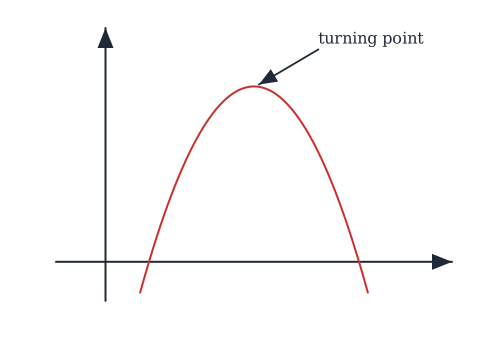
Where the graph turns
At the turning point we are, funnily enough, at the top of the graph. At this point the function goes from being increasing to being decreasing. The turning point can also be at the bottom of the graph. Then the function goes from decreasing to increasing instead.
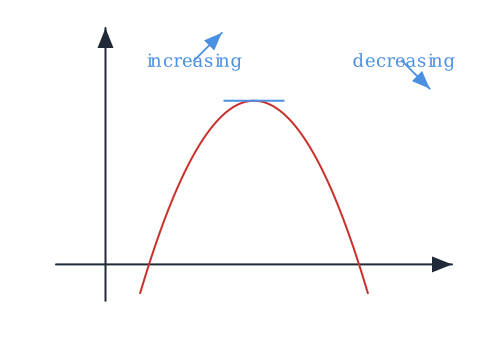
But exactly at the turning point, the function is neither increasing nor decreasing. The tangent at the turning point is completely horizontal. In other words, the gradient of the tangent at the turning point is .
Whether the turning point is the top or the bottom depends on . If is negative, the arms of the parabola point down and the turning point is the highest point on the graph. If is positive, the arms point up and the turning point is the lowest point.
The turning point formula
The formula looks like this:
With this formula we can find both the x-coordinate and the y-coordinate of the turning point. We can see that to find the x-coordinate we use the -value and the -value of our quadratic. To find the y-coordinate we use and the -value. That is the same part under the square root as in the quadratic formula.
The x-coordinate on its own also tells us which side of the y-axis the turning point lies on. If and have the same sign, comes out negative, so the turning point lies to the left of the y-axis. If they have different signs, it comes out positive and the turning point lies to the right.
Worked example
We have the quadratic
and we'd like to find the turning point. We use the turning point formula, where we really just put our values in. We can start by working out the part under the square root, . We put our values in and get
Now we can find the coordinates:
We put our values into the turning point formula:
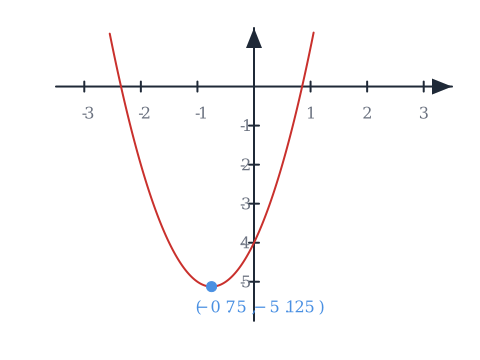
Now we've found the turning point of our quadratic. Notice that and have the same sign, and the turning point does lie to the left of the y-axis, just as the formula promised. And because is positive, the turning point is the bottom of the graph.
The y-coordinate without the formula
Normally, when we have an x-value and need to find a y-value, we just put the x-value in 's place and work out . That works here too. If we only remember the first half of the formula, , we can find the x-coordinate, and then put it into the function to get the y-coordinate:
Same answer, so the two ways agree. The formula just saves us the last step.
Common mistakes
- " is the whole answer." That's only the x-coordinate. The turning point is a point, so it has a y-coordinate too, from or from putting the x-value into the function.
- "I forgot the minus in front of ." The formula has on top. With that's , and with a negative it becomes positive.
- "I used instead of in the y-coordinate." The y-coordinate uses the whole of , so work that out first, exactly as when you solve the equation.
- "The turning point is always the highest point." Only when is negative. When is positive the arms point up and the turning point is the lowest point on the graph.
Related
Everything about , and , and the parabola itself, is in Quadratic functions and the parabola. The discriminant comes from solving quadratic equations with the formula, and the roots on either side of the turning point can be read off the factorised form.
Frequently asked questions
Read next
Want to get good at maths?
Mathara explains every topic step by step with videos, exercises and personal feedback.
👉 Get started for free