Maths dictionary
Power functions: graphs of y = b times x to the power a
A power function has the equation f(x) = b × x^a. Unlike an exponential function, the index a stays fixed and x is the base. Here is what b and a mean and the four shapes the graph can take, which is where the cubic graph and the reciprocal graph live.
Power functions contain a power of one kind or another. Like the other two types of function we've talked about, linear functions and exponential functions, the power function also has its own equation. It can look quite a bit like the exponential function, but there's a difference:
Here, in the equation of the power function, it isn't that's the index, but instead. The graph of a power function and the graph of an exponential function can still look very much alike, so it's worth keeping the two apart from the start: exponential is , power is .
What b means
We've been used to being where the graph crosses the y-axis, but in a power function it shows the y-value when is . That can seem a bit mysterious, but we can see it by putting in for :
Whatever we put in for , raised to it is still , so this becomes
So the b-value shows the function value at . On the graph below, every curve passes through the point for exactly that reason.
What a means
The a-value has a bit of the same meaning as in exponential functions, but in a power function the graph can look very different depending on . The a-value decides whether the function is increasing or decreasing, and how it curves.
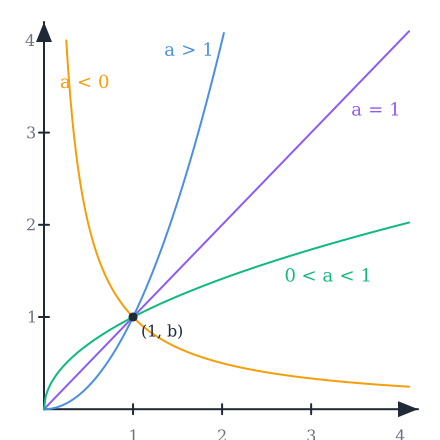
The four shapes on the graph are:
- : the graph falls, steeply at first and then flattening out towards the x-axis. The reciprocal graph from GCSE is this case with , because a negative index means .
- : the graph rises, but flattens out the further right you go.
- : the graph is a straight line through the origin, because .
- : the graph rises and gets steeper and steeper. The cubic graph is this case with and .
Power function or exponential function?
The two equations use the same letters, so mixing them up is the number one slip. Look at where the is:
- : the is in the index. That's an exponential function. It grows or falls by a fixed percentage per step, and it crosses the y-axis at .
- : the is the base and the index is fixed. That's a power function. It passes through , and its shape depends on as above.
Common misunderstandings
- "A power function and an exponential function are the same thing." No. In it's that's the index, not . Swapping their roles changes the whole shape of the graph.
- " is where the graph crosses the y-axis." Not here. In a power function is the function value at , because .
- " gives a power function." With we get , so : a constant, not a power function.
Related
Frequently asked questions
Read next
Want to get good at maths?
Mathara explains every topic step by step with videos, exercises and personal feedback.
👉 Get started for free