Maths dictionary
What is probability?
A probability is not a guess. It is the number of outcomes we want divided by the number of outcomes there are. Here is the short explanation with a dice, a drawer of socks and a coin.
Probability is the topic about how likely it is that things happen. That could be the probability of rolling a 6 when we throw a dice, or what the chance of winning the lottery is.
The thing to carry with you is that a probability isn't a guess. It's a number we get by counting: how many of the possible results are the ones we want. Once you see it that way, most of the topic is counting carefully and then dividing.
Outcomes and favourable outcomes
In probability we have a few words we use to describe what we want to find the probability of. The result of a situation like that, we call the outcome. If we roll a dice, the result we get is called the outcome. The favourable outcomes are the ones we want to find the probability of. If we want to find the probability of rolling a 4, 5 or 6 when we roll a dice, we call those outcomes the favourable outcomes.
- Outcome, the result that comes out when we roll the dice.
- Favourable outcomes, the outcomes we're interested in.
The probability of rolling a 4, 5 or 6
A dice has 6 sides it can land on, and we want to find the probability that it lands on 3 of those sides, so the probability that we roll a 4, 5 or 6. That means there are 3 out of 6 sides we can land on.
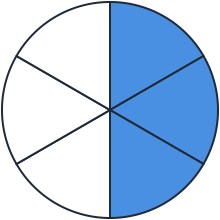
So there's a 50% probability of rolling a 4, 5 or 6. More generally we can say
We can only say that, though, because there is an equal probability of every outcome. There is the same probability of rolling a 1, 2, 3, 4, 5 or 6.
The socks in the drawer
Another example could be that we had 7 red socks and 6 blue socks in the drawer. What's the probability of pulling out a blue sock?
There are 13 socks in total and 6 of them are blue, so the probability is
Again we can only divide the favourable outcomes by the possible outcomes because there is the same chance for every outcome. That's what we call symmetric probability. In the exam you'll see it called equally likely outcomes, and it's the same condition: every sock is just as likely to be the one we pull out.
Fractions and percentages
As you can see, a probability comes out of the counting as a fraction: the favourable outcomes on top and the possible outcomes underneath. We can then write the same value as a percentage, so is and is about . Because the favourable outcomes are always some of the possible outcomes, the fraction is never more than 1, which is the same as . If you want the conversion itself explained, it's in the guide about fractions, decimals and percentages.
Several events in a row: the tree diagram
What if we toss a coin 3 times and want to know the probability of getting heads all three times? Here we can draw a tree diagram. For the first toss there are 2 outcomes, heads or tails. From each of those outcomes there are again 2 outcomes, and so on.
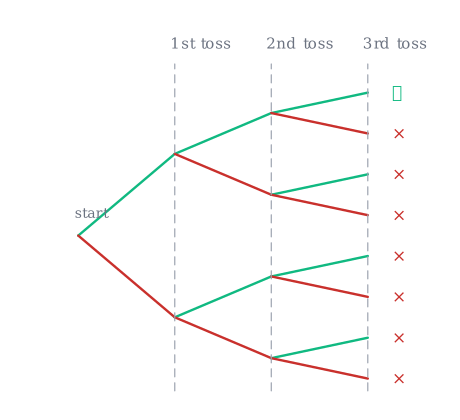
Every time we get heads the branch is green, and every time we get tails it's red. Our goal is heads on all 3 tosses, so all 3 have to be green. We can see on the tree that there is only one place where all 3 tosses give heads, so there is 1 out of 8 cases where we get 3 heads in a row.
The tree diagram is an easy and clear way to work out probabilities. We can actually also find the same answer without the tree, by multiplying: . The whole walkthrough is in the guide about tree diagrams.
The two rules: multiply for both-and, add for either-or
When every outcome has the same chance, there are two rules we use to find the probability of different things.
The first is the multiplication rule. We use it in situations we call both-and, for example when we want to know the probability of first rolling a 6 and then rolling a 3. The multiplication rule simply says that we multiply the probabilities of the separate events:
We can only use the multiplication rule when the events are independent of each other, which means that the first roll has no influence on what the second roll becomes.
The second is the addition rule. We use it in either-or situations, for example when we want the probability of getting either a 6 or a 3 in one roll. Here we add the probabilities:
When you get a question about probability, it's a good idea just to look for whether the situation is both-and or either-or. Once you know that, you can just use either the multiplication rule or the addition rule. Both rules get their own guide about the and rule and the or rule.
Common misunderstandings
- "Probability is a guess about what will happen." No. It's a number we get by counting the favourable outcomes and dividing by the possible outcomes. is not a feeling, it's 3 sides out of 6.
- "Favourable over possible works in every situation." Only when every outcome has the same chance. That's the condition we call symmetric probability, and it's why we keep checking it before we divide.
- "Rolling a 6 twice in a row is ." That's the classic mistake. First a 6 and then a 6 is a both-and situation, so we multiply: .
- "Whether events depend on each other is obvious, so I don't need to check." Even though it seems simple, it's important, when you work out probabilities, to judge whether the events depend on each other. The multiplication rule only works when they don't.
Related guides
- Tree diagrams in probability
- Independent events
- The and rule and the or rule
- Counting outcomes: tree diagrams and the product rule, where the same tree is used to count combinations instead of probabilities
Guides on this topic
Independent events
Two events are independent when the first has no influence on what the second becomes, like one coin toss and the next. It sounds obvious, but it decides whether you are allowed to multiply.
The and rule and the or rule: multiplying and adding probabilities
First a 6 and then a 3 is a both-and situation, so we multiply. A 6 or a 3 in one roll is either-or, so we add. Read the words in the question and the rule picks itself.
Tree diagrams in probability
A tree diagram draws every way a situation can turn out, one toss at a time. Then you count the paths you want against all the paths. Here it is for a coin tossed 3 times.
Frequently asked questions
Read next
Want to get good at maths?
Mathara explains every topic step by step with videos, exercises and personal feedback.
👉 Get started for free